How to Fix Short Cycling Air Conditioner
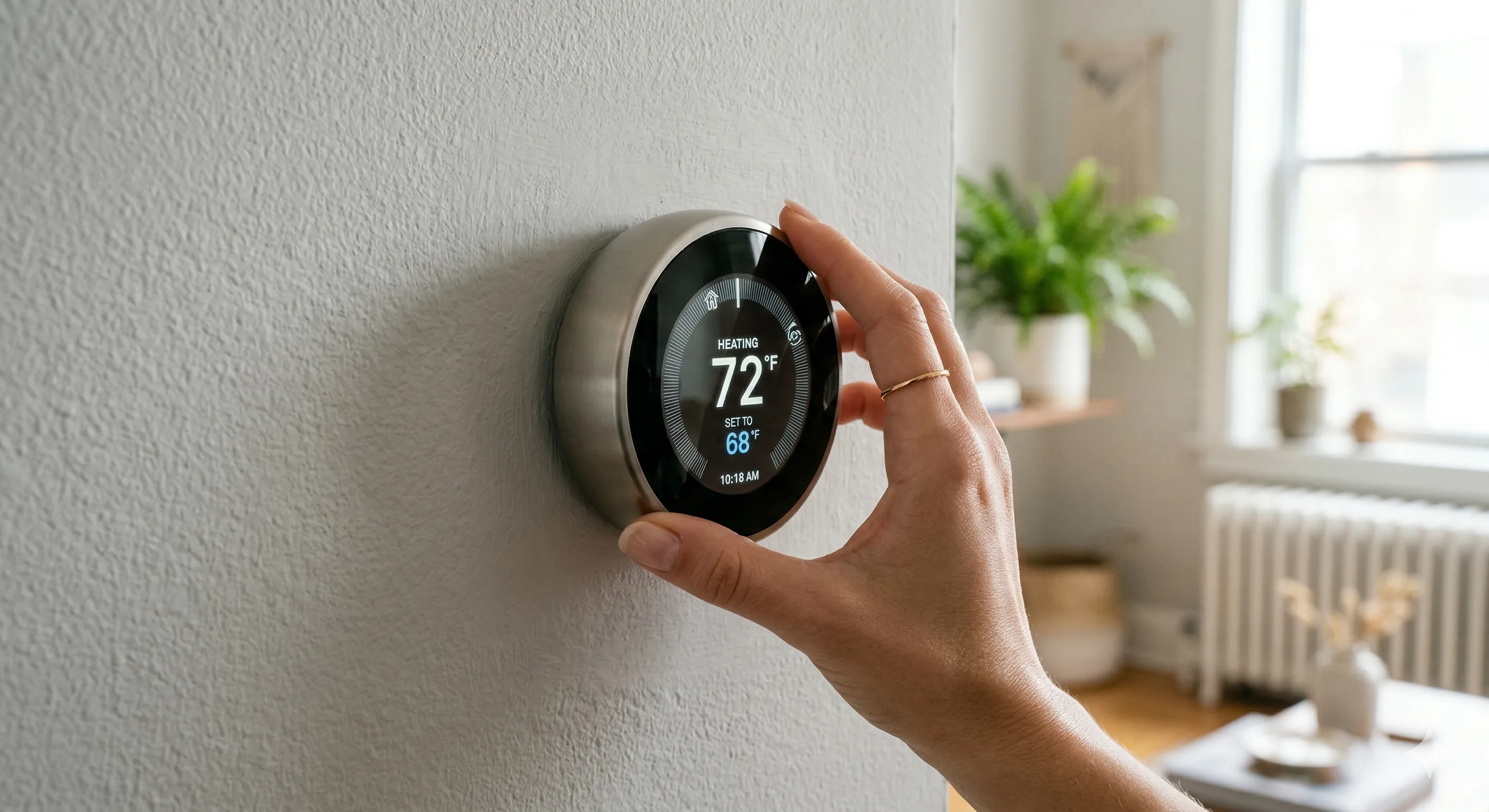
Your air conditioner starts up, runs for a few minutes, shuts off, then starts right back up again. Over and over. Instead of the normal 15–20 minute cooling cycles that keep your home comfortable, it's cycling on and off every 5–10 minutes — or sometimes even more frequently. This is called short cycling, and it's one of the most common — and most damaging — AC problems homeowners encounter.
Learning how to fix short cycling air conditioner problems starts with understanding the cause. Some fixes are free 5-minute DIY tasks (like replacing a clogged filter). Others require professional diagnosis and repair (like refrigerant leaks or compressor issues). This guide walks through all 10 common causes in order from simplest to most complex.
What Is Short Cycling?
A properly functioning air conditioner runs in cycles — the compressor turns on, cools the home until the thermostat is satisfied, then turns off and stays off until the temperature rises again. A normal cycle lasts 15–20 minutes, and the system might run 2–3 cycles per hour on a hot day.
Short cycling occurs when the compressor turns on and off more frequently than normal — typically every 5–10 minutes or less, running 4–8+ cycles per hour. In severe cases, the compressor may run for only 2–3 minutes before shutting off.
Why Short Cycling Is Dangerous for Your AC
Short cycling isn't just annoying — it actively damages your system:
- Compressor stress — every startup draws 4–8× the electrical current of normal running operation. This electrical surge stresses the motor windings, start capacitor, and contactor. More startups = more stress = shorter compressor life.
- Energy waste — those high-current startups are enormously wasteful. Short cycling can increase energy consumption by 20–40% compared to normal operation.
- Poor dehumidification — your AC removes humidity by running long enough for moisture to condense on the evaporator coil and drain away. Short cycles don't allow enough condensation time, leaving your home cool but clammy.
- Uneven temperatures — the system never runs long enough to fully distribute conditioned air, creating hot and cold spots
- Premature failure — a short-cycling AC can fail in 5–7 years instead of the expected 12–15 years, costing thousands in early replacement
10 Causes of Short Cycling and How to Fix Each One
1. Dirty or Clogged Air Filter (Most Common)
What happens: A dirty filter restricts airflow over the evaporator coil. Without sufficient airflow, the coil gets too cold (below 32°F), ice forms, and the system's safety controls shut the compressor off to prevent damage. After a few minutes, the ice melts slightly, the safety resets, and the compressor starts again — only to ice up and shut off again.
Fix: Check the air filter. If it looks gray, matted, or you can't see light through it, replace it immediately. This is a $5–$15 fix that solves short cycling in about 30% of cases.
DIY difficulty: ⭐ (easiest)
2. Thermostat Issues
What happens: Several thermostat problems can cause short cycling:
- Bad location — if the thermostat is near a supply vent, in direct sunlight, next to a hot appliance, or on an exterior wall, it reads a temperature that doesn't represent the room. The AC satisfies this false reading quickly, shuts off, then the actual room temperature triggers it back on.
- Dead batteries — low battery power can cause intermittent signal loss between the thermostat and the AC system
- Malfunctioning thermostat — the temperature sensor inside may be miscalibrated, reading the temperature as satisfied when it's not, then correcting
Fix: Replace batteries, verify the thermostat location is appropriate (interior wall, away from vents and windows, 4–5 feet from the floor), and compare the thermostat reading against a separate thermometer. If the thermostat is in a bad location, relocating it costs $100–$300 for an HVAC tech to rewire.
DIY difficulty: ⭐⭐
3. Frozen Evaporator Coil
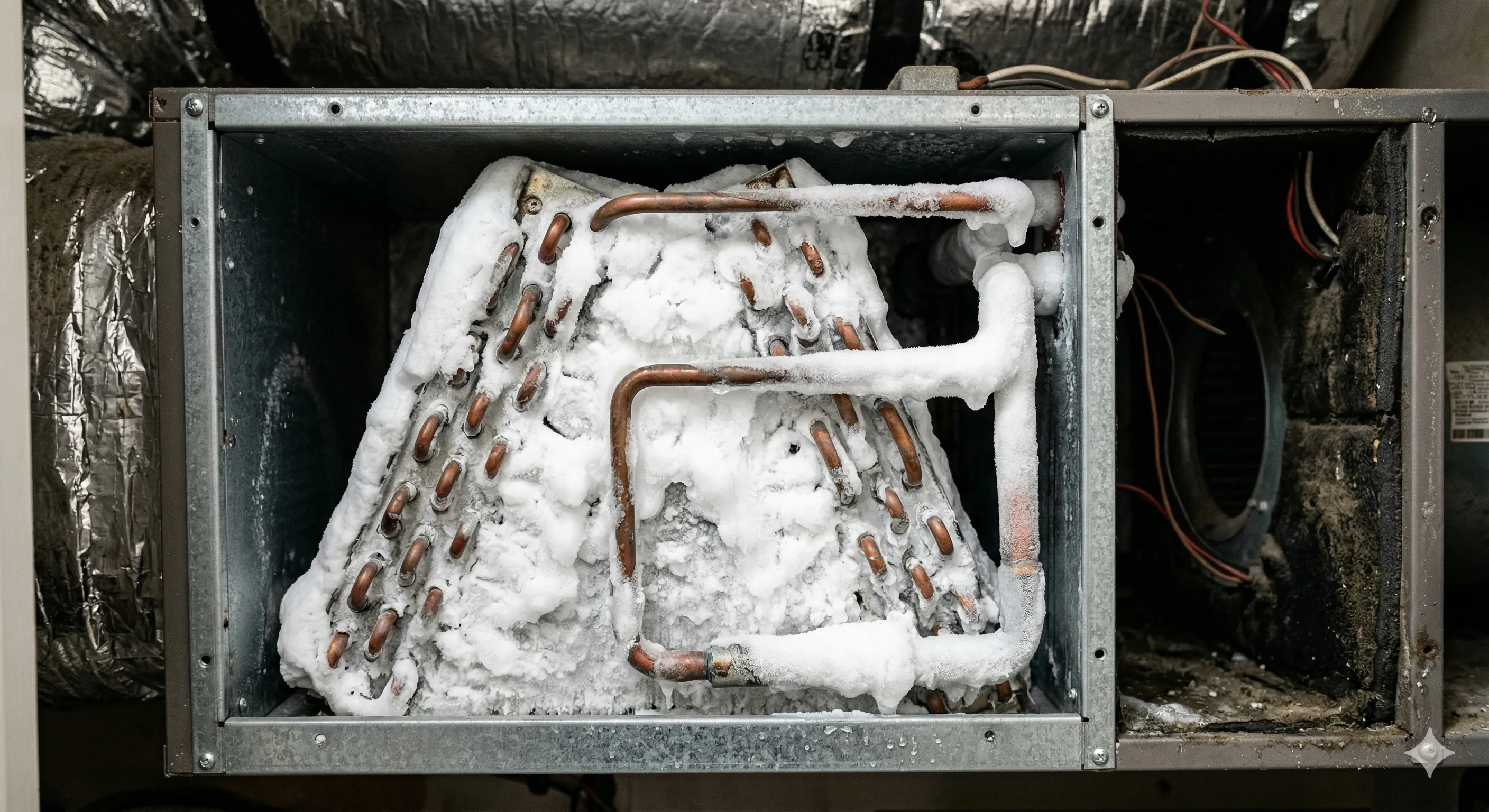
What happens: Ice buildup on the evaporator coil restricts airflow and insulates the coil from the air it's supposed to cool. The system overheats or triggers a safety cutoff, shuts down briefly, then restarts once the safety resets — but the ice hasn't fully melted, so the cycle repeats.
Fix: Turn the AC off completely. Set the fan to "on" (without cooling). Let the system run the blower only for 24 hours to thaw the coil. Then investigate the root cause: dirty filter (most common), low refrigerant, blocked return vent, or failing blower motor.
DIY difficulty: ⭐⭐ (thawing is DIY; root cause may need a pro)
4. Low Refrigerant (Refrigerant Leak)
What happens: Low refrigerant reduces the system's ability to absorb heat. The evaporator coil's pressure drops, its temperature drops below freezing, and ice forms. The system's low-pressure safety switch detects the abnormal pressure and shuts off the compressor. Pressure equalizes, the switch resets, and the compressor starts again.
Fix: This requires a professional. The technician will check refrigerant levels, find and repair the leak (leak search costs $200–$400), then recharge the system ($150–$600 depending on refrigerant type). Never just add refrigerant without finding the leak — it will just leak out again.
DIY difficulty: ❌ (professional only)
5. Oversized AC Unit
What happens: An AC that's too large for the space cools the air near the thermostat very quickly — sometimes in just 5–8 minutes. The thermostat is satisfied and shuts the system off. But the rest of the house hasn't been fully cooled, and the thermostat area quickly warms up from adjacent uncooled areas, triggering the system back on.
Fix: Unfortunately, the only permanent fix for an oversized unit is replacement with a properly sized system. A Manual J load calculation ($100–$300) determines the correct size. As interim measures: set the fan to "on" (distributes air more evenly), close blinds to reduce heat gain, or slightly lower the thermostat setting so the system runs longer cycles.
DIY difficulty: ❌ (requires system replacement)
6. Dirty Condenser Coils (Outdoor Unit)
What happens: The outdoor condenser coil releases heat from the refrigerant into the outside air. When covered in dirt, grass clippings, leaves, or cottonwood seeds, heat rejection drops. The compressor overheats and the high-pressure safety switch shuts it off.
Fix: Turn off the AC. Spray the outdoor coils with a garden hose from the inside out (not a pressure washer — too much force bends the fins). Remove any debris around the unit. Maintain 2 feet of clearance. For heavily soiled coils, apply a coil cleaner spray ($10–$15) first, wait 10 minutes, then rinse.
DIY difficulty: ⭐⭐
7. Failing Run or Start Capacitor
What happens: Capacitors store and deliver electrical charge to start and run the compressor and fan motors. A weak or failing capacitor can't deliver enough charge, causing the motor to start briefly then trip off on overload protection.
Fix: Professional repair. A technician tests the capacitor with a multimeter ($50–$200 for replacement including labor). This is one of the most common and affordable AC repairs.
DIY difficulty: ⚠️ (capacitors hold dangerous electrical charge — professional recommended)
8. Faulty Compressor
What happens: Internal valve or mechanical wear causes the compressor to overheat rapidly, triggering its internal thermal overload protector. The compressor shuts off, cools down, resets, and starts again — repeating the cycle.
Fix: Professional diagnosis. Compressor replacement costs $1,500–$3,000. On units over 8 years old, full system replacement is usually more cost-effective (see the AC lifespan guide for the $5,000 rule).
DIY difficulty: ❌ (professional only)
9. Electrical Problems
What happens: Loose wiring, corroded connections, or a failing contactor (the relay that delivers power to the compressor) can cause intermittent power delivery — the compressor starts, loses power, stops, regains power, and starts again.
Fix: Professional inspection of all electrical connections, contactor, and wiring. Contactor replacement: $100–$250. Wiring repair: $75–$200.
DIY difficulty: ❌ (professional only — risk of electrocution)
10. Blocked or Closed Supply Vents
What happens: Closing too many supply vents restricts airflow, building back-pressure in the duct system and reducing airflow over the evaporator coil — similar to a dirty filter effect.
Fix: Open all supply vents in the house. Despite the common myth, closing vents in unused rooms doesn't save energy — it actually increases duct pressure, causes leaks, and can lead to short cycling. Open all vents at least 75% for proper airflow.
DIY difficulty: ⭐ (easiest)
DIY Troubleshooting Checklist
Before calling a technician, work through these steps in order:
- ✅ Check and replace the air filter
- ✅ Replace thermostat batteries
- ✅ Verify thermostat location (away from vents, sun, appliances)
- ✅ Open all supply vents in the house
- ✅ Check the outdoor unit — clean debris, rinse coils, verify 2ft clearance
- ✅ Check the evaporator coil for ice (open the air handler panel)
- ✅ Check the condensate drain line — if clogged, the safety switch may be shutting the system off
- ✅ Reset the breaker — turn off the AC breaker for 30 seconds, then back on (this resets safety lockouts)
If none of these resolve the issue, call an HVAC technician. The remaining causes (refrigerant, capacitors, compressor, wiring) require professional tools and expertise.
When to Call a Professional
- Short cycling persists after replacing the filter and checking all DIY items
- You see ice on the evaporator coil or refrigerant lines
- The outdoor unit makes clicking, buzzing, or humming sounds without the compressor starting
- You smell a burning or electrical odor from the air handler or outdoor unit
- The circuit breaker trips when the AC tries to start
- The system is older than 10 years and short cycling has recently started
Short Cycling Repair Costs (2026)
| Repair | Cost (Parts + Labor) |
|---|---|
| Air filter replacement | $5–$30 (DIY) |
| Thermostat replacement | $75–$300 |
| Thermostat relocation | $100–$300 |
| Capacitor replacement | $100–$250 |
| Contactor replacement | $100–$250 |
| Refrigerant leak repair + recharge | $350–$1,500 |
| Evaporator coil replacement | $800–$2,500 |
| Compressor replacement | $1,500–$3,500 |
| Full system replacement (if oversized) | $4,000–$10,000 |
Preventing Future Short Cycling
- Replace the filter monthly during peak cooling season
- Schedule professional maintenance twice yearly
- Keep the outdoor unit clean and clear
- Install a surge protector to prevent electrical component damage
- Ensure proper sizing when replacing the system — insist on a Manual J calculation
- Keep all supply vents open
Want to learn more about HVAC systems?
Read Our Complete HVAC Guide →Frequently Asked Questions
More HVAC Guides
You May Also Like
How to Tarp a Roof
Step-by-step guide to emergency roof tarping after storm damage. Protect your home from water damage with proper tarp installation.
How Much Hail Damage to Replace Roof
Learn what level of hail damage qualifies for a full roof replacement through your insurance. Adjuster criteria explained.
How to Measure Windows
Precise window measuring guide for replacements. Width, height, and depth measurements with diagrams.
How to Measure a Door Jamb
Step-by-step door jamb measurement for replacement doors. Get the right fit every time.
Disclaimer: This content is for informational purposes only. Electrical work on HVAC systems should be performed by licensed technicians. HouseFixGuide may earn a commission from links on this page.