Composite Decking vs Wood
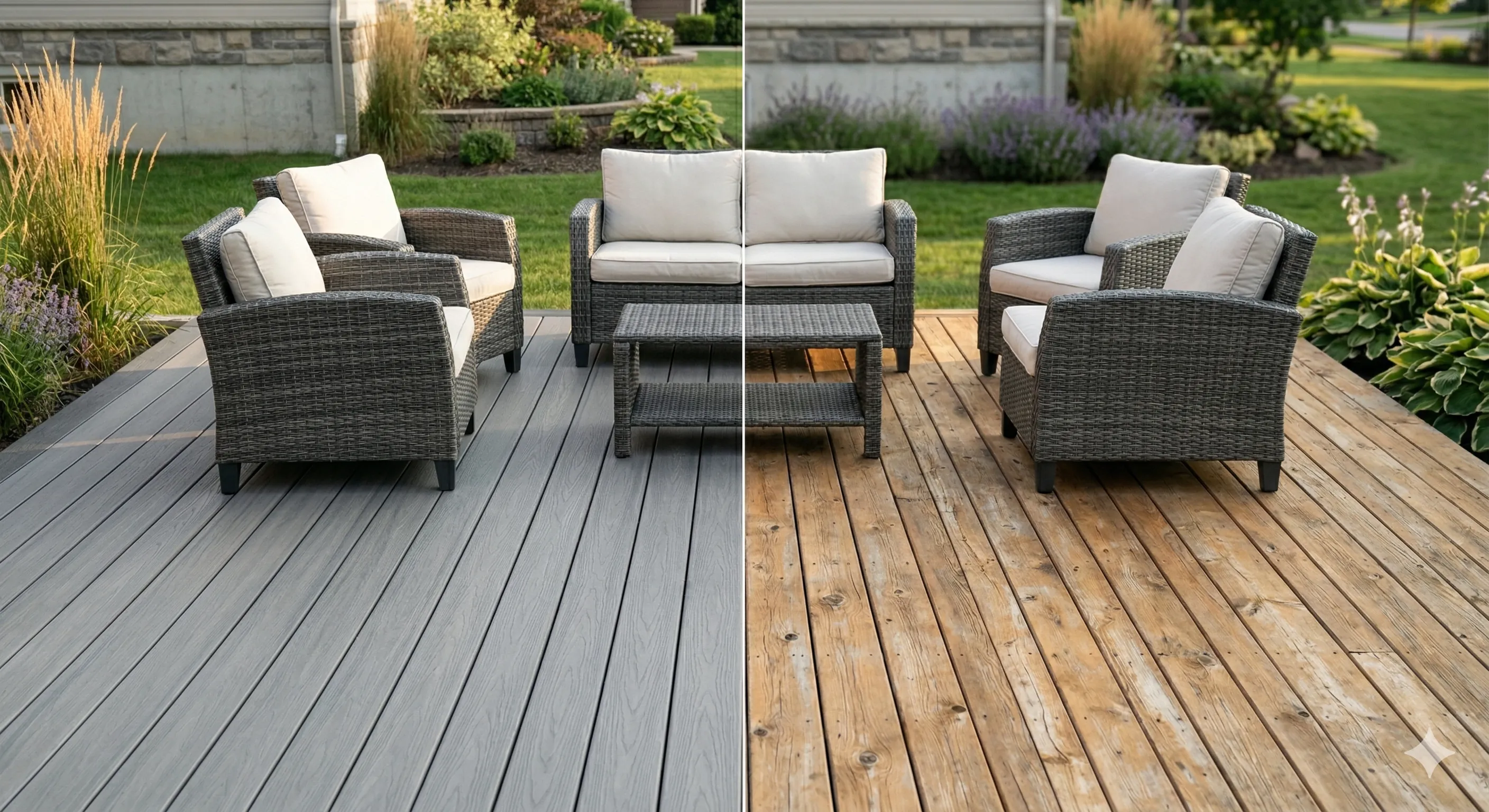
Choosing between composite decking and wood is one of the biggest decisions in deck building. It affects your budget, how much time you'll spend on maintenance for years to come, how the deck looks and feels, and how long it lasts. Neither option is universally "better" — the right choice depends on your budget, priorities, and how you plan to use the deck.
Quick Comparison Table
| Factor | Wood (Pressure-Treated) | Composite |
|---|---|---|
| Upfront cost (installed) | $15–$25/sqft | $23–$45/sqft |
| 20-year total cost | $35–$55/sqft | $25–$48/sqft |
| Lifespan | 15–25 years | 25–50 years |
| Maintenance | Annual staining/sealing | Occasional cleaning |
| Appearance | Natural, ages to gray | Consistent, varied colors |
| Heat retention | Moderate | Hotter in sun |
| Splinters | Yes | No |
| Warranty | Limited (material only) | 25–50 year structural + fade |
| Eco-friendly | Chemically treated | Made from recycled materials |
Cost Comparison: Upfront and Long-Term
Upfront Material and Installation Costs
| Material | Material Only (per sqft) | Installed (per sqft) |
|---|---|---|
| Pressure-treated pine | $2–$5 | $15–$25 |
| Cedar | $4–$8 | $20–$30 |
| Redwood | $7–$12 | $25–$35 |
| Ipe (tropical hardwood) | $10–$20 | $30–$50 |
| Composite (budget: Trex Enhance) | $4–$8 | $23–$32 |
| Composite (mid: Trex Select) | $6–$10 | $28–$38 |
| Composite (premium: Trex Transcend/TimberTech Pro) | $9–$14 | $35–$45 |
| PVC decking (AZEK) | $10–$16 | $38–$50 |
20-Year Total Cost of Ownership
This is where the comparison shifts dramatically in composite's favor:
- Wood maintenance costs: Staining/sealing every 1–2 years ($500–$1,500 per application for a 300 sqft deck). Over 20 years: $5,000–$15,000 in maintenance alone.
- Wood replacement: Pressure-treated wood decks typically need board replacement starting around year 10. Full deck replacement around year 15–20.
- Composite maintenance costs: Annual power washing and occasional soap cleaning. Cost: $50–$100/year. Over 20 years: $1,000–$2,000.
For a 300 sqft deck over 20 years:
| Category | Pressure-Treated Wood | Mid-Range Composite |
|---|---|---|
| Installation | $6,000 | $10,000 |
| Maintenance (20 yrs) | $10,000 | $1,500 |
| Repairs/replacement | $2,000 | $0 |
| Total | $18,000 | $11,500 |
Maintenance Requirements
Wood Deck Maintenance
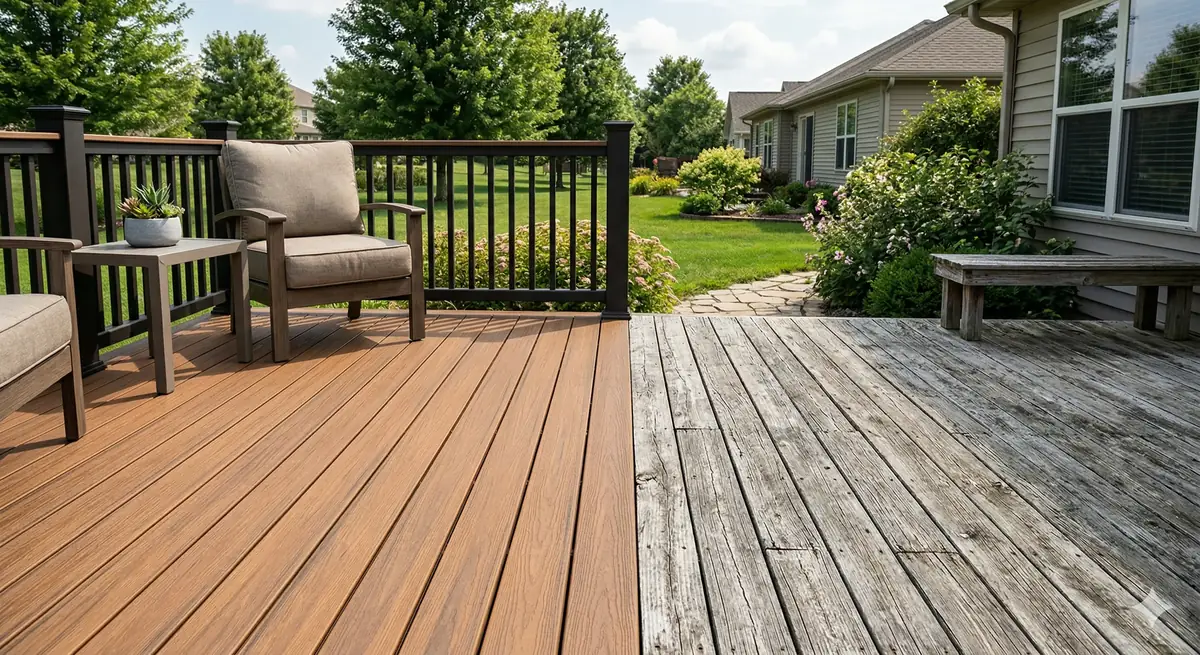
- Annual or biennial staining/sealing — possibly the biggest commitment of wood deck ownership. Without it, UV exposure grays the wood within 6 months and moisture causes rot, warping, and cracking.
- Power washing before restaining (required to open wood pores)
- Board replacement — individual boards crack, warp, or rot and need replacement over time
- Fastener maintenance — nails and screws pop up as wood expands/contracts, requiring re-setting
- Mold and mildew treatment — especially on shaded decks
Composite Deck Maintenance
- Occasional cleaning — soap and water, power washing, or a deck cleaner 1–2× per year
- No staining, sealing, or painting — ever
- No board replacement under normal use
- No splinter repair
- Mold/mildew cleaning — composite can develop surface mold in shaded, humid areas. It cleans off easily but doesn't penetrate the material.
Durability and Lifespan
Wood
- Pressure-treated pine: 15–25 years with proper maintenance, 8–12 years without
- Cedar: 15–20 years (naturally rot-resistant but soft and prone to denting)
- Ipe: 25–40 years (extremely hard and durable, but expensive)
- Vulnerabilities: rot, insect damage (especially termites and carpenter ants), warping, cracking, splitting, UV fading, mold
Composite
- Budget composite: 25–30 years
- Premium composite: 30–50 years
- PVC (AZEK): 30–50 years
- Vulnerabilities: heat retention (gets hot in sun), can scratch, early-generation products were prone to fading (modern composites have significantly improved UV resistance)
Appearance
Wood Appearance
Nothing truly replicates the look and feel of real wood. The natural grain, warmth, and character of cedar, redwood, or ipe are unmatched. However, wood changes appearance dramatically: it grays within months without stain, and maintaining a consistent color requires diligent restaining.
Composite Appearance
Modern composite decking has improved dramatically from the flat, plastic-looking products of the 2000s. Premium composites now feature:
- Multi-tonal streaking that mimics natural wood grain
- Embossed textures that replicate wood surface patterns
- Wide color selections from weathered gray to rich mahogany
- Consistent appearance that doesn't change over time (minimal fading, no graying)
However, even the best composite doesn't perfectly replicate real wood to a trained eye. Up close, it looks manufactured. From a distance, most people can't tell the difference.
Environmental Impact
- Wood: Pressure-treated wood contains chemical preservatives (copper-based compounds like ACQ or CA). End-of-life disposal requires special handling — treated wood should never be burned. Cedar and redwood are harvested from forests (look for FSC-certified sustainable sources).
- Composite: Made from recycled materials (wood fibers + recycled plastic bags). Trex uses 500 million pounds of recycled material annually. No tree harvesting required. However, composite cannot itself be recycled at end of life in most areas.
Pros and Cons Summary
Wood Pros
- ✅ Lower upfront cost
- ✅ Natural, authentic look and feel
- ✅ Easy to cut, shape, and customize on-site
- ✅ Stays cooler in direct sun
- ✅ Can be refinished to change color
Wood Cons
- ❌ Requires annual maintenance (staining, sealing)
- ❌ Shorter lifespan (15–25 years)
- ❌ Splinters
- ❌ Vulnerable to rot, insects, warping
- ❌ Higher total cost over 15+ years
Composite Pros
- ✅ Virtually maintenance-free
- ✅ 25–50 year lifespan
- ✅ No splinters
- ✅ Won't rot, warp, or crack
- ✅ Lower total cost over 15+ years
- ✅ Made from recycled materials
Composite Cons
- ❌ Higher upfront cost
- ❌ Gets hotter in direct sunlight
- ❌ Can't be refinished or stained a different color
- ❌ Doesn't perfectly replicate real wood up close
- ❌ Heavier than wood (harder to handle during installation)
Which Is Best for You?
- Choose wood if: You're on a tight upfront budget, you love the natural look of real wood, you're willing to maintain it annually, or you want a material you can refinish and change colors.
- Choose composite if: You want low maintenance, you plan to stay in the home 7+ years (to realize the cost savings), you want consistent appearance over decades, or you have a larger budget for upfront investment.
- Consider Ipe or PVC if: Budget isn't the primary concern and you want maximum durability (30–50 years) with the beauty of hardwood (Ipe) or the ultimate in moisture resistance (PVC/AZEK).
Top Composite Decking Brands (2026)
| Brand | Lines | Price Range (per sqft) | Warranty |
|---|---|---|---|
| Trex | Enhance, Select, Transcend | $4–$14 | 25–50 years |
| TimberTech (AZEK) | Edge, Pro, Advanced PVC | $5–$16 | 25–50 years |
| Fiberon | Good Life, Horizon, Concordia | $4–$12 | 25–50 years |
| MoistureShield | Vision, Elevate, CoolDeck | $5–$11 | 30–50 years |
| Deckorators | Voyage, Vault | $4–$9 | 25 years |
For more deck and outdoor project guides, visit our outdoor and decks resource center.
Want to learn more about outdoor projects?
Read Our Complete Outdoor & Decks Guide →Frequently Asked Questions
More Outdoor & Decks Guides
Related Guides
- Planning a gravel path or driveway? See our gravel driveway cost guide
- Compare driveway costs per square foot
You May Also Like
How Thick Should Concrete Be for a Driveway
Proper concrete thickness for driveways by use case. Standard cars, heavy vehicles, and code requirements explained.

How Much Does Concrete Lifting Cost
Mudjacking vs foam jacking costs compared. Average prices, when lifting works, and when replacement is better.
How Do Electrical Fires Start
The 10 most common causes of electrical fires in homes. Warning signs, prevention measures, and emergency response.
How Long Do Electrical Panels Last
Electrical panel lifespan by type, dangerous recalled brands (FPE, Zinsco), and upgrade costs.
Disclaimer: This content is for informational purposes only. Prices vary by region and market conditions. HouseFixGuide may earn a commission from links on this page.