HVAC: The Complete Guide to Heating, Cooling & Air Quality
Browse Articles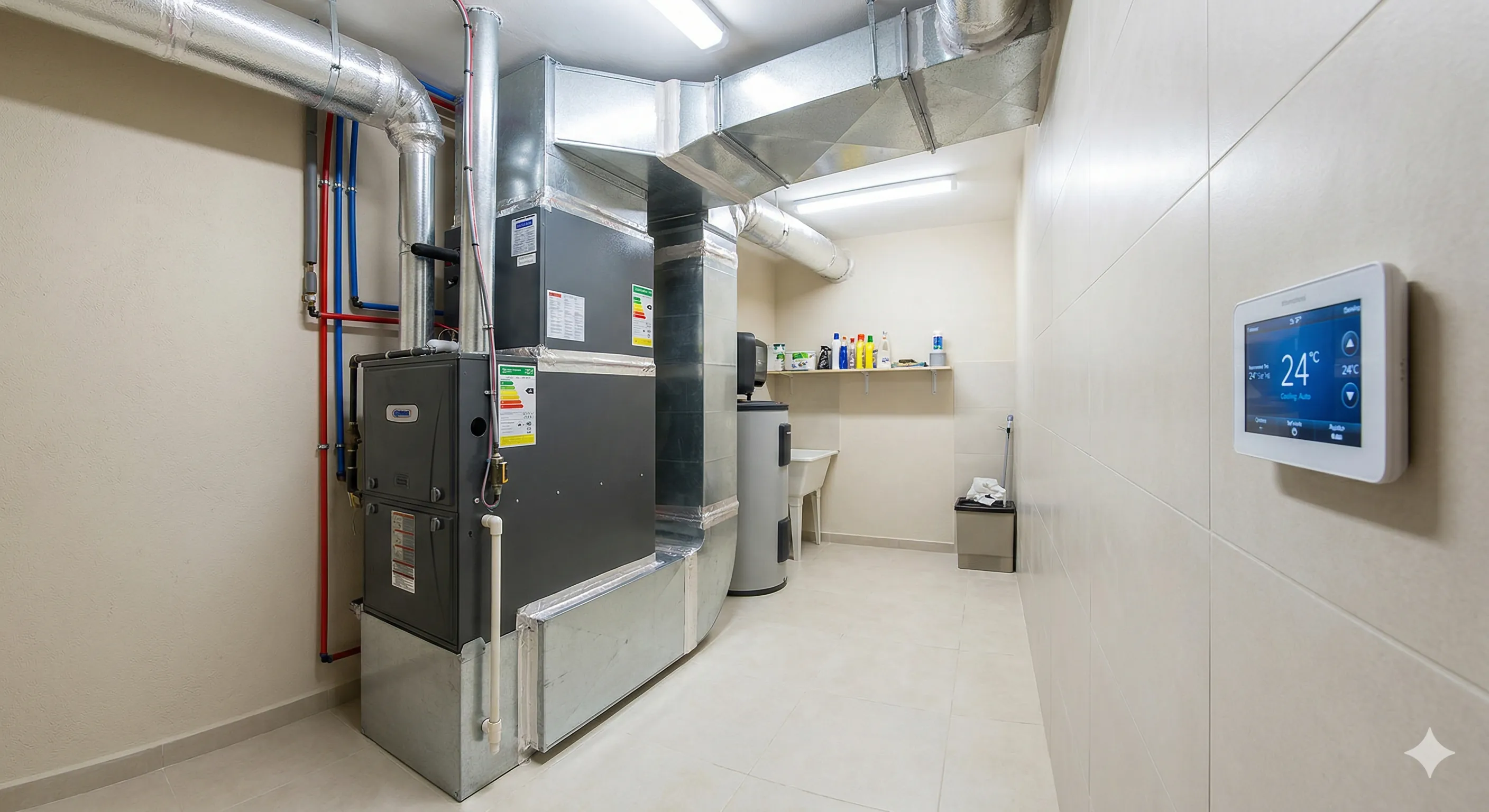
Your HVAC system — heating, ventilation, and air conditioning — is the most expensive mechanical system in your home. It keeps you warm in winter, cool in summer, and controls indoor air quality year-round. When your HVAC system fails on the hottest day of summer or the coldest night of winter, it becomes an urgent emergency that can cost thousands in emergency service calls.
This comprehensive HVAC guide covers everything homeowners need to know about their heating and cooling system — from basic troubleshooting and filter maintenance to understanding heat pump technology, thermostat wiring, and knowing when repair versus replacement makes financial sense. Being an informed HVAC owner saves you money on energy bills, extends equipment life, and prevents you from being oversold on unnecessary services.
How Your HVAC System Works
A central HVAC system has three main subsystems that work together:
- Heating — typically a gas furnace (most common in the U.S.), heat pump, electric furnace, or boiler. The furnace or heat pump generates warmth, and a blower fan pushes heated air through the ductwork to every room.
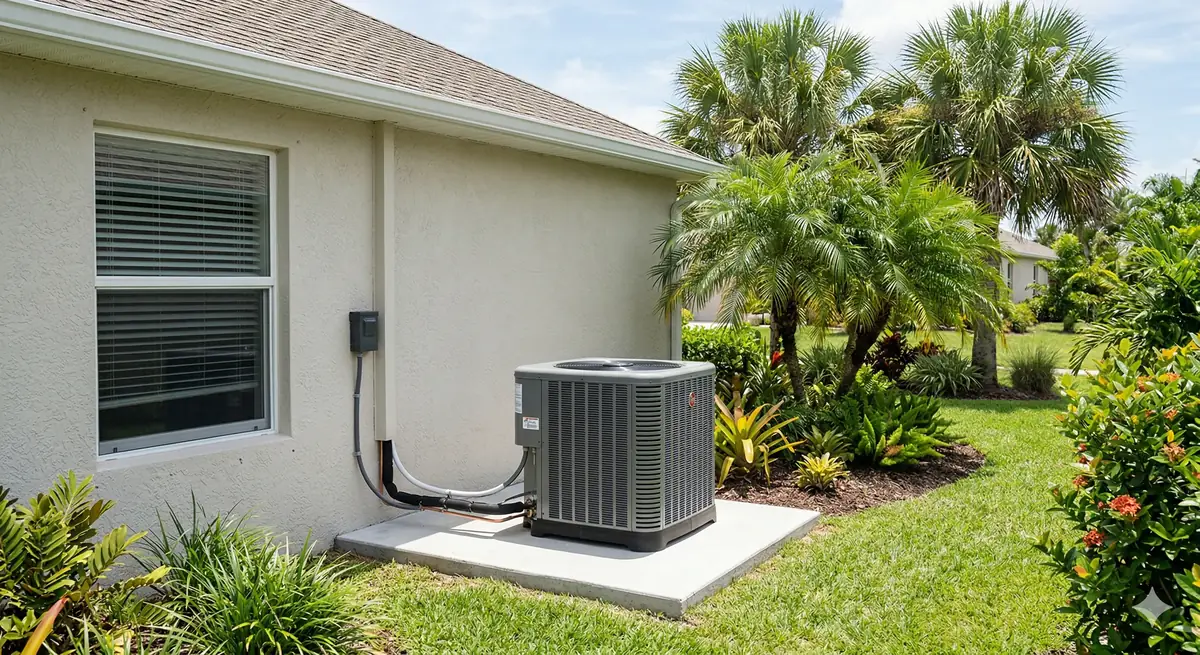
- Cooling — the air conditioner or heat pump uses refrigerant to absorb heat from indoor air and dump it outside. The indoor evaporator coil absorbs heat; the outdoor condenser coil releases it. Refrigerant circulates between the two coils via copper lines.
- Ventilation — ductwork distributes conditioned air throughout the home and returns air back to the system. The air filter cleans the return air before it passes over the evaporator coil and heat exchanger.
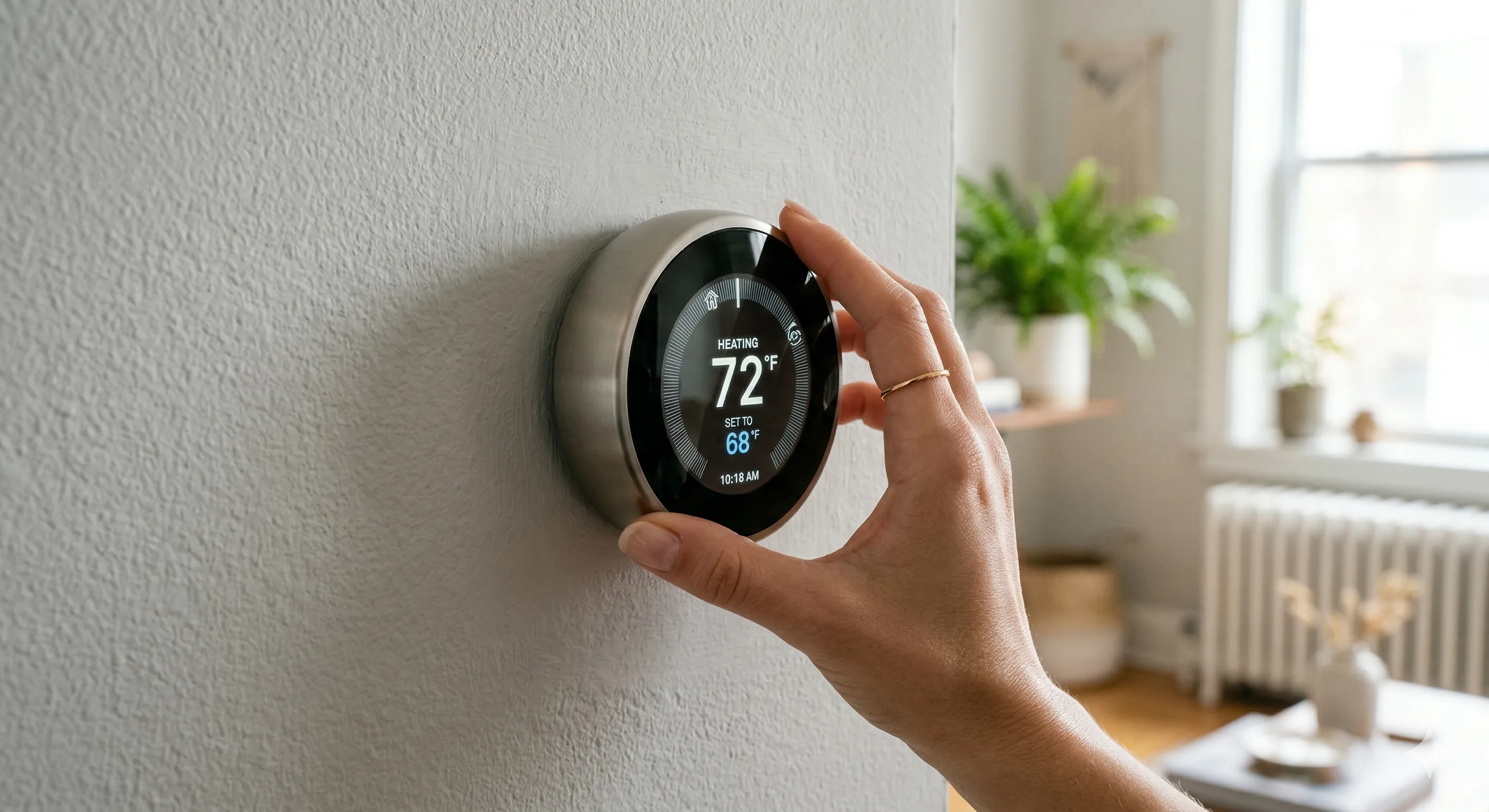
The thermostat is the control center — it reads the room temperature, compares it to your set temperature, and signals the appropriate equipment (furnace, AC, or heat pump) to turn on or off. Modern smart thermostats like the Nest, Ecobee, and Honeywell Home learn your patterns and adjust automatically to save energy.
Air Filters: The #1 HVAC Maintenance Task
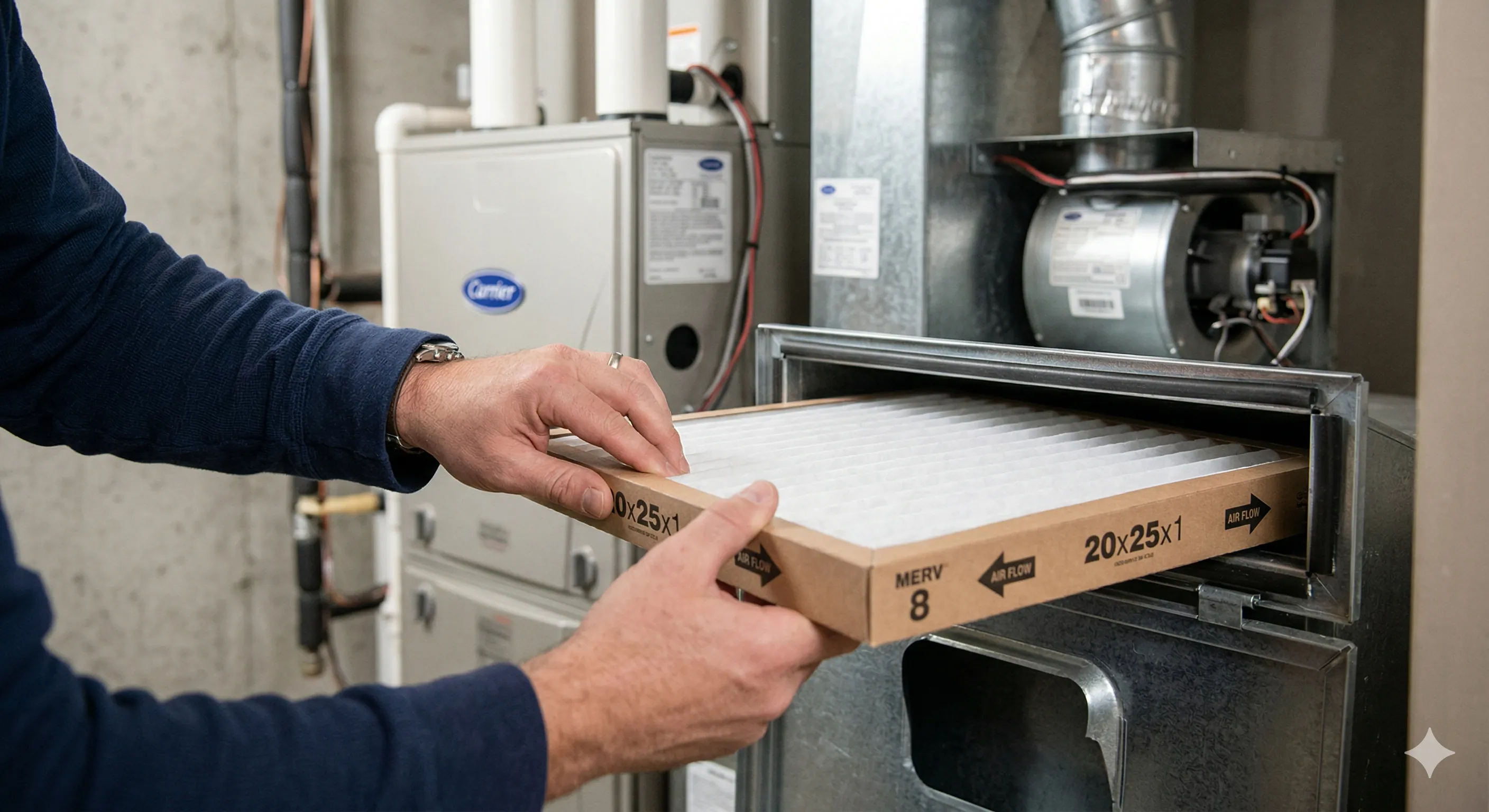
If you do only one thing for your HVAC system, change the air filter regularly. A clogged, dirty filter is the single most common cause of HVAC problems and the easiest to prevent.
Filter Replacement Schedule
- 1-inch fiberglass filters — replace every 30 days
- 1-inch pleated filters — replace every 60–90 days
- 4-inch pleated filters — replace every 6–12 months
- Homes with pets, allergies, or heavy dust — change more frequently (reduce intervals by 25–50%)
Understanding MERV Ratings
MERV (Minimum Efficiency Reporting Value) rates a filter's ability to capture particles:
| MERV Rating | Captures | Best For | Impact on Airflow |
|---|---|---|---|
| 1–4 | Large particles (pollen, dust mites) | Minimal filtration, budget | Minimal restriction |
| 5–8 | Mold spores, pet dander | Most residential systems | Low restriction |
| 9–12 | Fine dust, auto emissions | Allergy sufferers, better air quality | Moderate restriction |
| 13–16 | Bacteria, tobacco smoke | Hospital-grade, special needs | High — verify system compatibility |
Important: Don't assume a higher MERV filter is always better. High-MERV filters restrict airflow more, which can reduce system efficiency and even damage your HVAC equipment if the blower can't handle the resistance. MERV 8–11 is the sweet spot for most residential systems — effective filtration without excessive airflow restriction. Check your HVAC manual or ask your technician before upgrading above MERV 11.
Furnace Troubleshooting
When your furnace stops producing heat, there are several common causes you can check before calling an HVAC technician:
Furnace Not Starting
- Check the thermostat — make sure it's set to "Heat" and the temperature is set above the current room temperature. Replace thermostat batteries if the screen is blank.
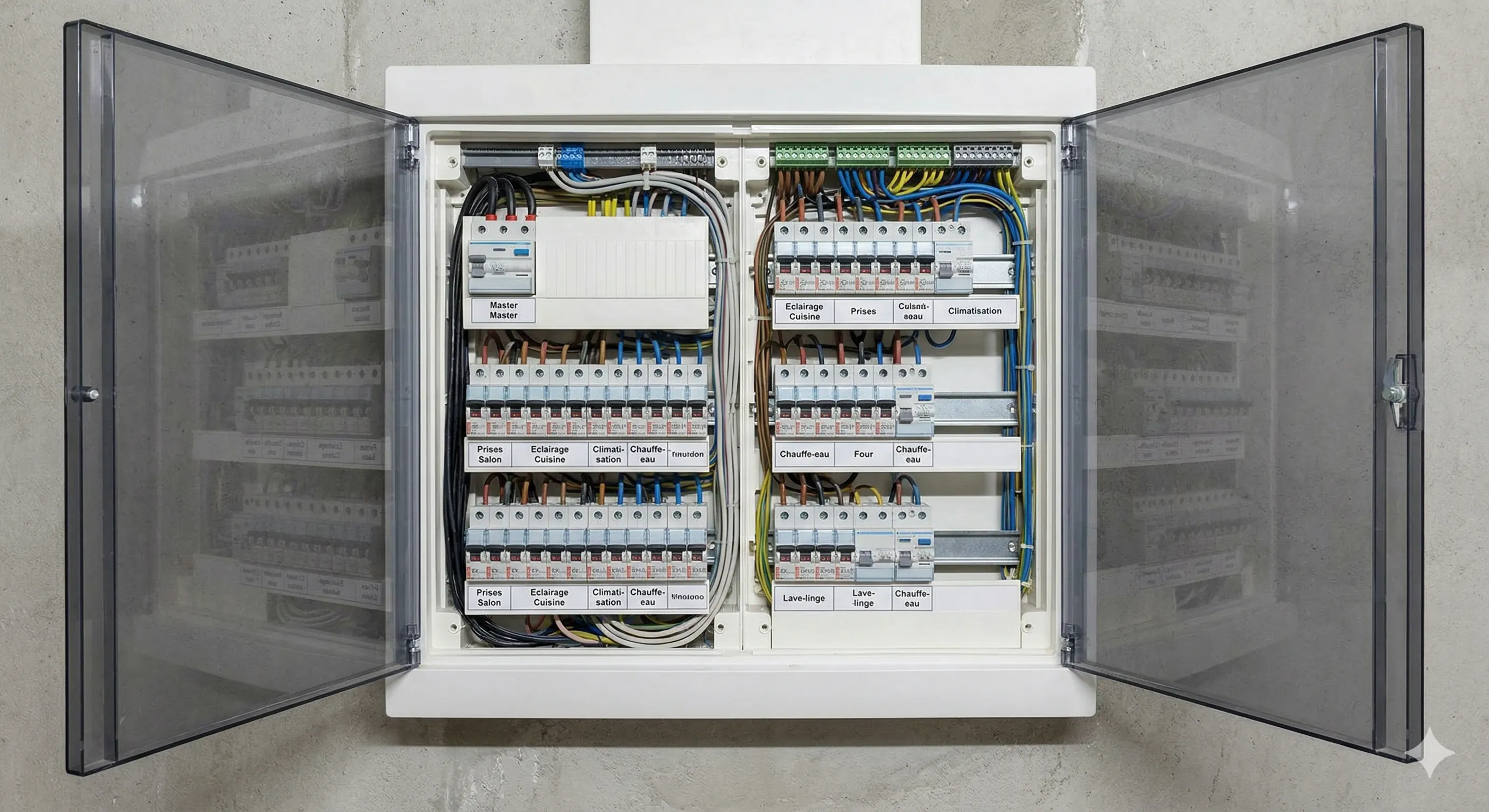
- Check the circuit breaker — even gas furnaces need electricity for the blower, igniter, and controls. Reset a tripped breaker.
- Check the furnace power switch — there's usually a light switch on the side of the furnace or nearby wall. Make sure it's ON.
- Check the gas valve — the gas valve handle should be parallel to the pipe (on). Perpendicular means it's off.
- Check the air filter — an extremely clogged filter can trigger the high-limit switch, which shuts down the furnace as a safety measure
Furnace Running but No Heat
- Igniter failure — modern furnaces use a hot surface igniter (HSI) instead of a pilot light. If the igniter cracks or burns out, the gas won't light. Replacement cost: $100–$300 with labor.
- Flame sensor dirty — a dirty flame sensor tells the control board there's no flame, shutting off gas flow. Cleaning with fine sandpaper or steel wool often fixes the issue ($0 DIY, $80–$150 professional).
- Blower motor failure — the furnace heats up but can't push air through the ducts. You may hear the burners ignite but feel no airflow from vents.
- Clogged condensate drain — high-efficiency (90%+) furnaces produce condensation. If the drain line clogs, a safety switch shuts down the furnace.
Air Conditioning Problems & Fixes
Common AC problems homeowners can diagnose (and sometimes fix) before calling a professional:
- AC not turning on — check thermostat settings, breaker, and outdoor disconnect switch. The outdoor unit has its own breaker that may have tripped.
- AC running but not cooling — first check the air filter. A severely clogged filter prevents airflow over the evaporator coil, which can freeze up. Also check that the outdoor unit isn't blocked by bushes, debris, or a cover left on from winter.
- Frozen evaporator coil — caused by low refrigerant, restricted airflow (dirty filter), or a failing blower motor. Turn off the AC and let it thaw for 2–4 hours with the fan set to "ON" before troubleshooting further.
- Refrigerant leak — if your AC gradually loses cooling ability over weeks, it likely has a refrigerant leak. This requires a licensed HVAC technician with EPA certification to diagnose and repair. Never try to add refrigerant yourself.
- Short cycling — the AC turns on and off rapidly (every few minutes). Common causes: oversized unit, dirty filter, low refrigerant, or a faulty thermostat.
Thermostat Wiring & Programming
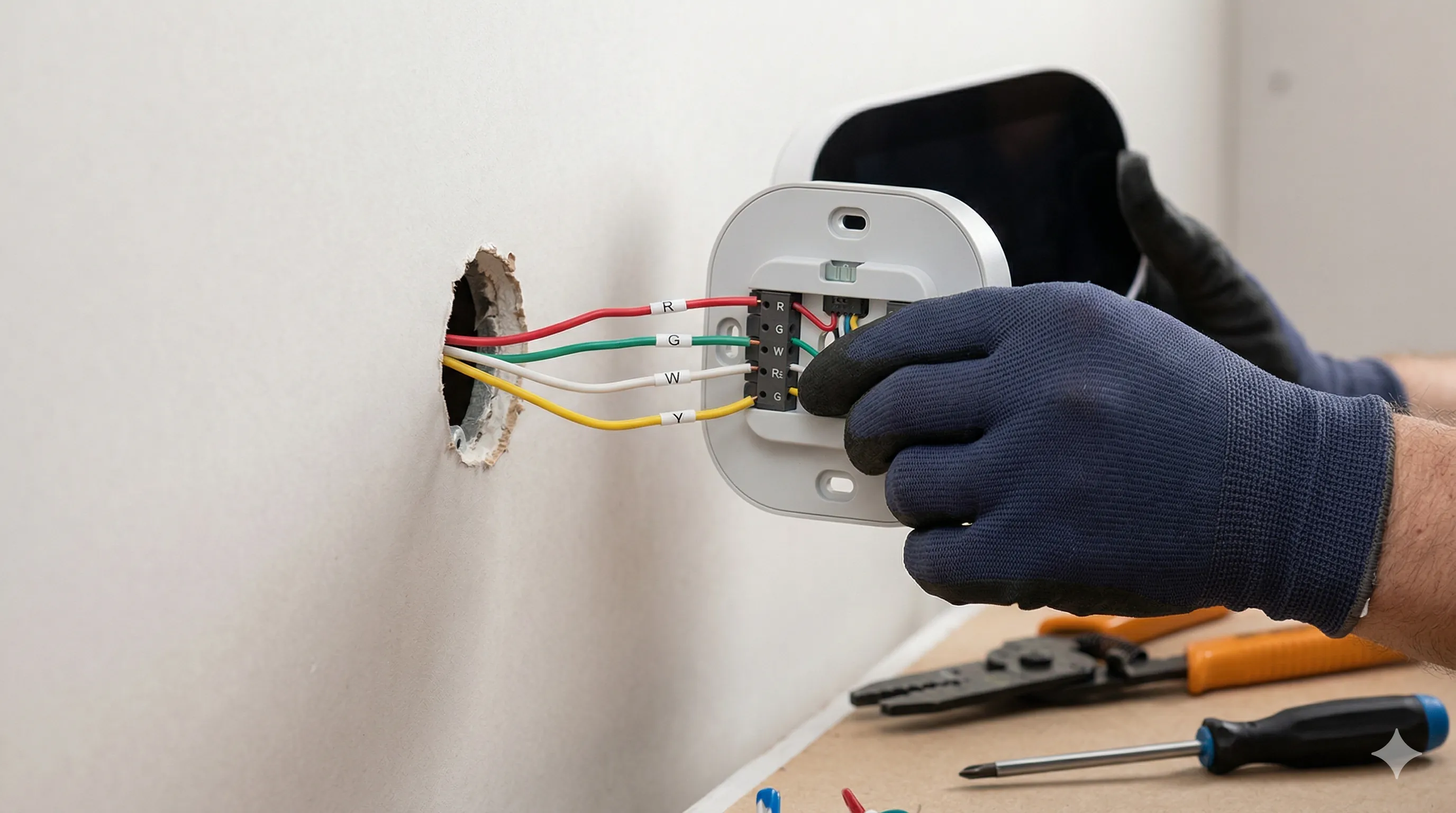
Thermostat problems account for a surprising number of HVAC service calls. Knowing how thermostat wiring works helps you troubleshoot issues and even install a new thermostat yourself.
Common Thermostat Wire Colors
| Wire Color | Terminal | Function |
|---|---|---|
| Red (R) | R / Rh / Rc | 24V power from transformer |
| White (W) | W / W1 | Heating (furnace) |
| Yellow (Y) | Y / Y1 | Cooling (AC compressor) |
| Green (G) | G | Fan (blower) |
| Blue / Common (C) | C | Common wire (24V return — needed for smart thermostats) |
| Orange (O/B) | O/B | Heat pump reversing valve |
If you're upgrading to a smart thermostat (Nest, Ecobee), you need a C wire (common wire) to provide continuous 24V power. Older thermostats ran on battery or powered through the signal wires. If your existing thermostat cable doesn't include a C wire, options include: running a new cable, using an "add-a-wire" adapter kit ($25–$40), or using a plug-in transformer adapter.
Heat Pumps Explained
Heat pumps are the fastest-growing HVAC technology and the future of home heating and cooling. A heat pump doesn't generate heat — it moves heat from one place to another, making it 2–3 times more energy-efficient than traditional furnaces and electric heaters.
How Heat Pumps Work
In cooling mode, a heat pump works identically to a standard AC — it absorbs heat from indoor air and dumps it outside. In heating mode, it reverses the process: even when it's cold outside, there's still heat energy in the outdoor air (down to about 0°F for modern cold-climate heat pumps). The heat pump extracts this energy and brings it inside.
Types of Heat Pumps
- Air-source heat pump — most common; exchanges heat between indoor and outdoor air. Cost: $4,000–$8,000 installed. Works well down to about 25–30°F for standard models, 0°F for cold-climate models.
- Mini-split (ductless) heat pump — wall-mounted indoor units connected to an outdoor compressor. No ductwork needed. Ideal for room additions, converted garages, and homes without existing ductwork. Cost: $3,000–$6,000 per zone.
- Geothermal heat pump — uses underground loops to exchange heat with the constant-temperature earth. Most efficient option (300–500% efficiency) but most expensive to install ($15,000–$35,000). Lowest operating cost of any HVAC system.
Ductwork & Airflow
Even a perfect HVAC system performs poorly if the ductwork is leaky, undersized, or badly designed. The Department of Energy estimates that the average home loses 20–30% of conditioned air through duct leaks — meaning you're paying to heat or cool your attic, crawlspace, and walls.
Signs of Ductwork Problems
- Some rooms are significantly hotter or colder than others
- Visible dust blowing from vents when the system starts
- High energy bills despite a properly functioning HVAC system
- Flexible ductwork that's kinked, crushed, or disconnected in the attic
- Musty or dusty smells from the vents
Ductwork Solutions
- Seal duct joints — use mastic sealant or UL-listed metal-backed tape (NOT standard duct tape, which fails within months). Focus on connections at the furnace, register boots, and branch takeoffs.
- Insulate ducts — ducts running through unconditioned spaces (attic, crawlspace) should be insulated to R-6 or higher
- Professional duct testing — a blower door test or duct leakage test quantifies exactly how much air you're losing
Proper HVAC Sizing
An oversized HVAC system is just as problematic as an undersized one. An oversized AC short-cycles (turns on and off rapidly), fails to dehumidify properly, and wears out faster. An undersized system runs constantly and never reaches the set temperature on extreme days.
Proper HVAC sizing requires a Manual J load calculation, which considers your home's square footage, insulation levels, window area, climate zone, orientation, and air leakage rate. A rough rule of thumb is 400–600 sq ft per ton of cooling, but this varies enormously — a well-insulated 2,000 sq ft home might need only 2.5 tons, while a poorly insulated home of the same size might need 4 tons.
HVAC Costs in 2026
| Equipment/Service | Cost Range | Lifespan |
|---|---|---|
| Central AC replacement | $3,000–$7,000 | 15–20 years |
| Gas furnace replacement | $2,500–$6,000 | 15–25 years |
| AC + furnace combo | $5,000–$12,000 | 15–20 years |
| Air-source heat pump | $4,000–$8,000 | 12–15 years |
| Mini-split (per zone) | $3,000–$6,000 | 15–20 years |
| Geothermal heat pump | $15,000–$35,000 | 20–25 years (50 for loops) |
| Smart thermostat | $150–$300 installed | 7–10 years |
| Annual maintenance tune-up | $75–$200 | Recommended yearly |
Seasonal HVAC Maintenance Checklist
Every 1–3 Months
- Check and replace the air filter
- Clear the area around the outdoor unit — maintain 2 feet of clearance on all sides
Spring (Before Cooling Season)
- Clean the outdoor condenser coil — rinse with a garden hose from inside out
- Check refrigerant lines for damage or insulation degradation
- Test the AC by setting the thermostat 5°F below room temperature — it should start cooling within a few minutes
- Clean condensate drain line — flush with 1 cup of white vinegar or bleach
Fall (Before Heating Season)
- Schedule a professional furnace tune-up ($75–$150)
- Test the heating by setting the thermostat 5°F above room temperature
- Check for unusual sounds, smells, or delayed ignition
- Verify carbon monoxide detectors are working (replace batteries)
Frequently Asked Questions About HVAC
HVAC Articles
Related Topics

Disclaimer: This content is for informational purposes only. HVAC refrigerant handling requires EPA certification. Always consult licensed HVAC professionals for system repairs. HouseFixGuide may earn a commission from links on this page.